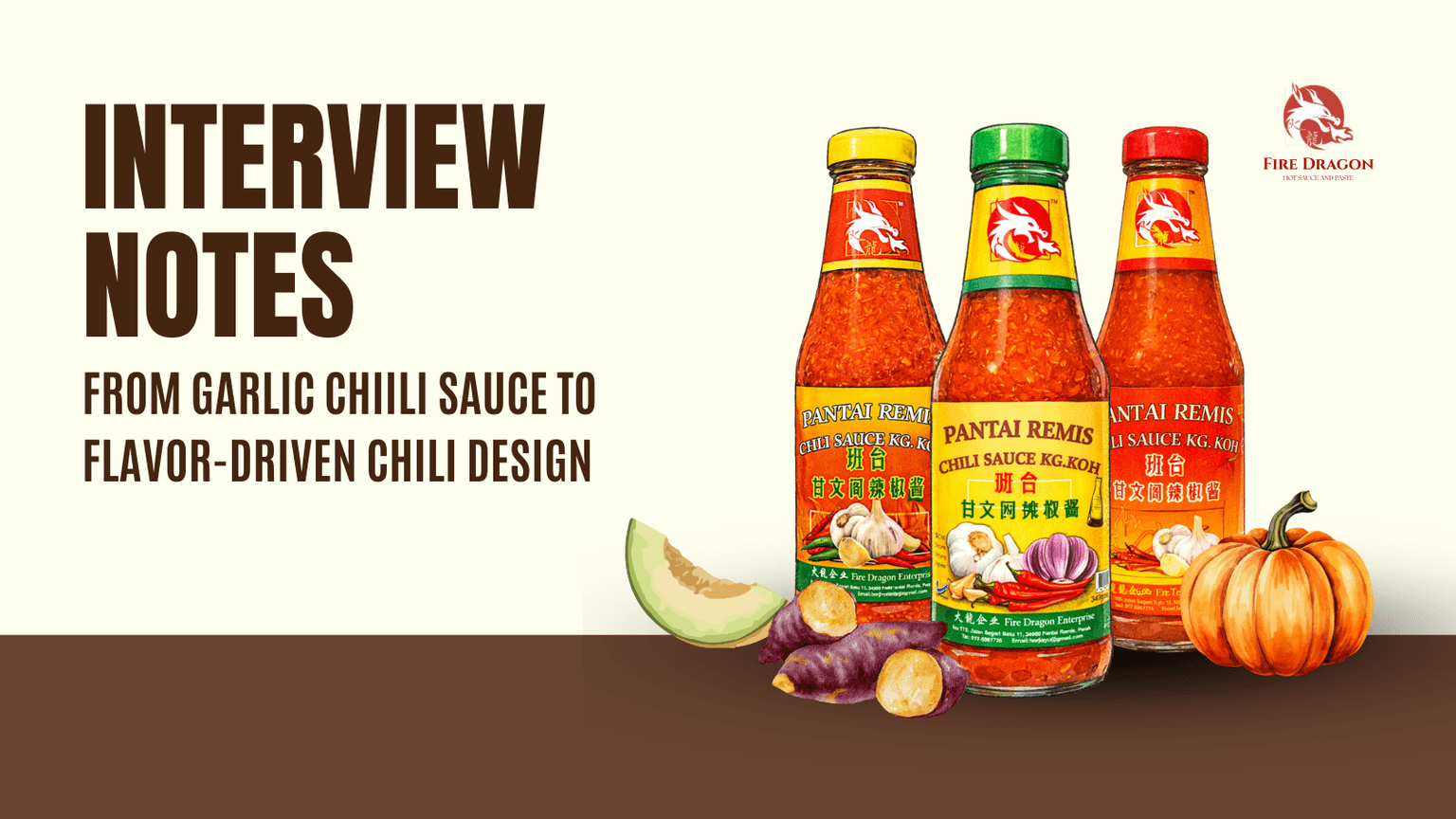
This article is compiled from multiple interviews with the founder of Fire Dragon. It documents how an ordinary food practitioner gradually stepped away from mainstream methods and moved toward flavor-oriented design through long-term experimentation.
1. From a Producer’s Perspective, Chili Sauce Has a “Default Formula”
From a production standpoint, most chili sauces on the market are not particularly complicated. They usually follow a relatively fixed structure: garlic, chili, oil, water, and a small amount of starch to control thickness. Variations are often straightforward. For example, Thai-style chili sauce replaces starch with sugar; some add fish sauce to make it saltier; others use lime or calamansi to create the sour chili sauce commonly served with chicken rice; and some cook chili together with belacan, dried shrimp, and other seasonings to form sambal or dried shrimp chili.
In a home kitchen, this logic works perfectly. When we first started making chili sauce, we also began here, choosing the most basic and widely accepted version: garlic chili sauce. On one hand, it was the easiest flavor for the market to accept. On the other hand, our experience at the time suggested that simpler formulas were easier to stabilize and preserve. After all, the sour chili sauce used in chicken rice stalls is not meant to be stored for long.
2. In the Beginning, We Viewed Chili Sauce Through a Consumer’s Perspective
Looking back, our understanding of chili sauce did not start from a “research” perspective. During preparation and market observation, we evaluated products, competitors, and trends much like ordinary consumers.
At that time, our criteria for making chili sauce were very direct:
- If it tasted bad, you could tell in one bite, and no one would buy it again.
- If it wasn’t bad, it was acceptable, and people would buy it if the price was right.
- If it suited the palate and felt easy to eat, people would repurchase.
As for why something tasted good or where the differences lay, even we couldn’t explain it clearly. We felt that most chili sauces on the market weren’t unpleasant, but depending on what you dipped them with, they could taste slightly different.
So we assumed that price, spiciness, and aroma were essentially what the market cared about. Still, a few questions lingered: Why do the same few brands always sell best? If everyone’s formula is similar, where does the real difference come from? Why does something taste good, and why does something else fail?
3. When Flavor Is Scaled Up to Production, Problems Begin to Appear
The first real turning point came when we attempted large-scale production. In a restaurant setting, chili sauce was cooked in small batches of a few kilograms. But when production scaled to tens or even hundreds of kilograms at a time, everything changed.
Only then did we realize that the final flavor of chili sauce depends not only on ingredient ratios, but also on processing order, heating temperature and duration, and the interaction between oil, water, and starch. Without any experience in mass production, simply scaling up a “home-style” method led to our first production failures.
Before we finally produced chili sauce that was good enough to sell, many batches were discarded. After throwing away enough sauce, even the act of discarding became routine. Jokes aside, after repeated comparisons, a few batches eventually came close to the taste we remembered from home cooking. We then prepared packaging and moved toward market release.
The first acceptable batch wasn’t particularly impressive. Freshly cooked, it tasted fine when dipped with fried chicken—perhaps because the chicken itself was good. It could sell, but it left no strong impression. Customers wouldn’t ask, “Do you still have that chili sauce from last time?”
More importantly, as storage time increased, the flavor gradually changed. It didn’t spoil, but something felt off—the taste and color shifted. At the time, we didn’t realize this was flavor degradation, what we now call the flavor appreciation period passing. We only sensed that something was wrong without being able to explain it.
4. When Mainstream Methods Reached Their Limit
After noticing this issue in the market, we immediately tried to adjust our production techniques and formulas based on previous experience. Yet no matter how much we tweaked, the problem remained: the sauce tasted fine when freshly cooked, but deteriorated over time.
Self-doubt followed. Where exactly was the problem? Was it even possible to continue?
Eventually, a seemingly unconventional idea emerged. If chili varieties, starch ratios, and garlic proportions had all been tested without significant improvement, could we add something else?
The first ingredient we considered was sweet potato. The reasoning was simple: since starch and sugar were already used to control thickness and sweetness, what would happen if we used sweet potato directly?
The result surprised us. The flavor didn’t become strange; instead, it became smoother. The texture stabilized and poured more easily. More importantly, this batch made people instinctively want to dip again. This marked the starting point of what later became the green-cap chili sauce, and the first time we realized that even with chili remaining the main character, flavor could still move forward.
5. When Further Attempts Led to Flavor Conflicts
Encouraged by the success of sweet potato, we naturally experimented with other fruits and vegetables. That’s when a new problem emerged:
When too many ingredients were added together, the flavor became vague—not unpleasant, but confusing. Different flavors interfered with each other, and the focus was lost.
We realized that the issue wasn’t whether to add ingredients, but whether they could coexist. Not everything belongs together, and forced combinations only create chaos.
6. The Three Variants Were Never Planned From the Start
The three versions that later appeared were not the result of early market planning, but rather a natural—or unavoidable—outcome.
Some ingredients performed well under certain ratios but compromised other qualities we valued, such as smoothness or freshness. Trying to keep everything led to mediocrity. Accepting that not everything could be achieved at once, we chose to separate them.
Through targeted adjustments, different flavor focuses were preserved, forming the three versions seen today. Their detailed design logic will be discussed in separate upcoming articles.
7. Technology Moved Ahead, but the Market Did Not
As our flavor techniques stabilized, these chili sauces became consistently producible, relatively shelf-stable, and slow to change in taste. However, market response fell short of expectations.
When we mentioned that fruits or vegetables were used, some shop owners reacted cautiously, even labeling it unconventional. Eventually, we stopped emphasizing the ingredients and let them judge by taste instead. Ironically, promotion became easier that way.
Despite being stocked in many shops, we often heard, “Your chili sauce doesn’t sell well.” Each time, it hit our confidence hard.
8. The Decision That Changed Everything
With sales stagnating, the true turning point came not from flavor itself, but from a decision. The founder believed that technical improvements had reached their limit; the real issue was a lack of visual identity. On the shelf, the product looked “just like the others,” discouraging trial.
So we made a bold move. We invested in visual differentiation—a custom pink bottle cap and clean white labeling that stood apart from anything else on the shelf. That was how Bird’s Eye Chili Sauce was born.
It is still a flavored chili sauce, built on our accumulated flavor expertise, but with a sharper approach: more acidity, more heat, and less sweetness. The difference was immediate, clear, and memorable.
9. From Uncertainty to Validation
Bird’s Eye Chili Sauce didn’t become popular overnight. At first, we were worried about the high cost of large packaging. But after several sales cycles, it outperformed the three variants that had previously stagnated. We even started receiving inquiries from overseas, including customer from Hunan.
This didn’t mean the journey was over. It simply confirmed one thing:
This unconventional path wasn’t wrong. There was still room to explore.
10. Refinement Over Replacement
The three original variants still exist today. They aren’t bestsellers, but they have loyal customers. For us, the question isn’t whether to discontinue them, but whether to keep refining them.
In upcoming articles, we’ll explore how pumpkin, winter melon, and sweet potato each affect flavor, texture, and flow—making “flavor” something understandable and selectable.
Conclusion: Flavor Is Not About Pleasing Everyone
There’s no single definition of the perfect chili sauce. Some people focus on spiciness, others care more about aroma, and some pay attention to how it feels after eating.
What we can do is explain each choice clearly. In the end, what matters most is what you enjoy.