Interview Note
This article is based on interviews and first-hand accounts from the founder of Fire Dragon Enterprise,
structured and edited for clarity and continuity.
Certain timelines and details have been simplified where appropriate.
This Sauce Did Not Appear Overnight
For many people, their first encounter with Fire Dragon begins with a bottle of sauce, a piece of packaging, or a product page online.
It may look like the brand simply appeared one year and was quickly turned into a business.
But if you trace the story back to its beginning, you will find that this was never a moment of sudden inspiration.
Long before the name Fire Dragon existed, this road had already been walked for nearly twenty years.
Before Fire Dragon, the Journey Had Already Begun
Before making sauces, the founder had already spent many years working in food and distribution-related industries.
There was no early plan to build a brand, and certainly no clear R&D roadmap.
At that time, the most practical question was simple:
How do you make a living through food?
Because of this, the path was never a straight line.
It shifted repeatedly as life entered different stages.
Running Restaurants Far from Home
In the early years, the founder worked in the food business around Johor.
Hainanese chicken rice was sold. Bak kut teh was sold.
Business was not bad, and it provided a modest income.
But the problem was obvious — it was far from home.
There was little long-term planning then, just moving forward with whatever opportunity was available.
It was only when marriage came into view that the reality became clear:
a life constantly away from home was not sustainable.
So the decision was made to return to the hometown — Pantai Remis, Perak.
Back Home, Continuing Food Business in a Different Way
After returning home, a company was set up together with several familiar partners.
This time, instead of running a shop, the work shifted toward distribution — supplying raw materials to grocery stores and small businesses.
It was a very grounded kind of business:
- Building relationships
- Delivering goods
- Carrying stock
- Low margins, relying on volume
It depended on physical effort, trust, and time, and through it came exposure to many people in the distribution channels.
When Life Changes, Old Models Stop Working
After having a child, a life spent constantly on the road became increasingly unrealistic.
Combined with limited experience in corporate management and formal systems, the company eventually came to an end.
There were no grand lessons or startup post-mortems at that point — just reality.
That path was no longer viable.
In search of stability, a grocery shop was opened.
But it quickly became clear that a fixed location with limited foot traffic made earning a living even harder.
Back to the Kitchen, Once Again
When the grocery shop failed to provide stability, the founder returned to what he knew best —
opening a small eatery serving bak kut teh and stir-fried dishes.
Business was acceptable, but the pace was exhausting.
Dinner hours left almost no room to breathe.
During quieter moments, attention naturally turned back to sauces.
Not to start a business — simply to make the flavours better.
Looking Back, These Experiences Were Not Random
Only in hindsight did it become clear that none of these experiences were isolated.
Nearly everything revolved around three core questions:
- Food itself
- How to move products through the market
- How to preserve them safely
At the time, it was not obvious that these experiences were laying the foundation for what would come later.
After a series of family-related events, the founder decided to start again.
In 2010, Fire Dragon Enterprise was established under these circumstances.
How the First Product Failed
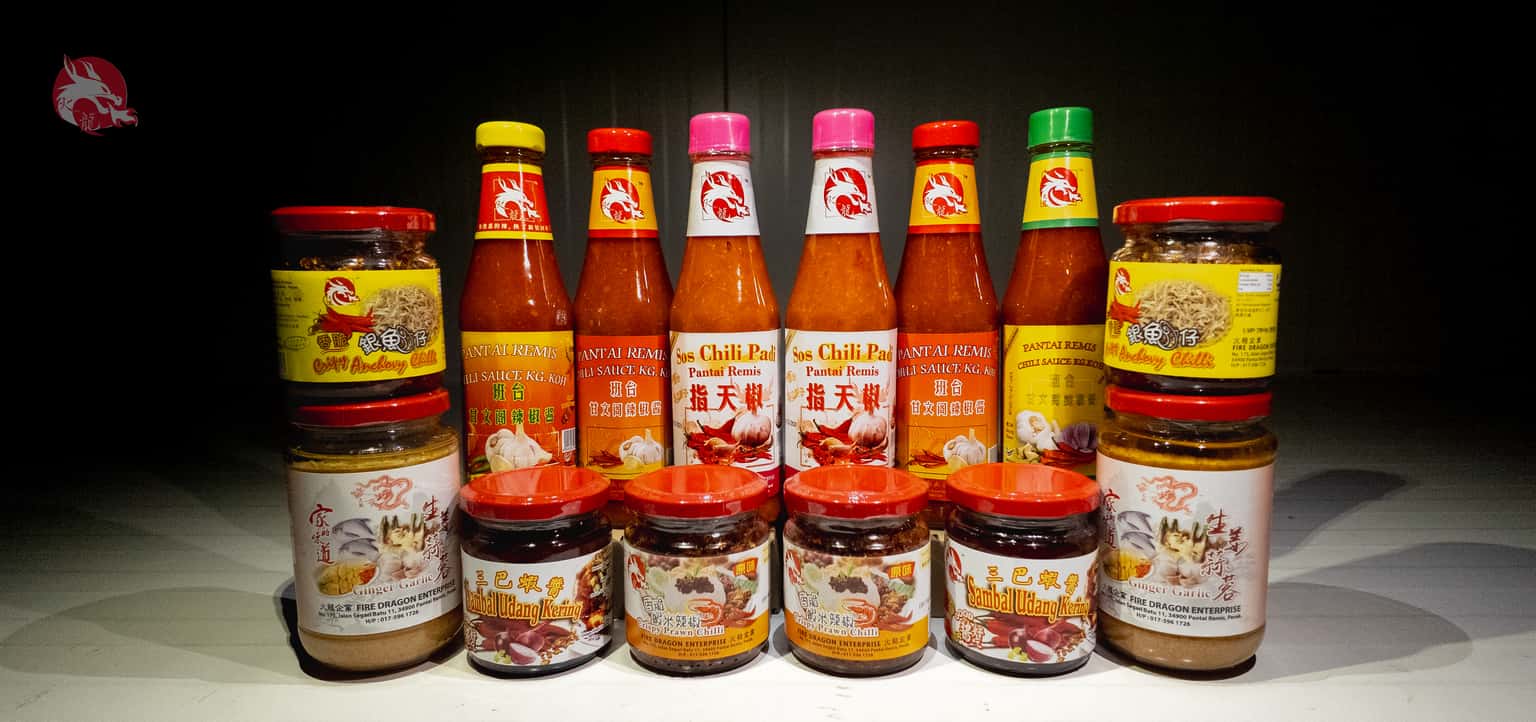
Fire Dragon’s first product was a very traditional chilli sauce.
From a process perspective, it was as simple as it gets:
- Sourcing raw ingredients
- Cleaning and chopping
- Cooking
- Bottling
- Sealing
- Packaging
- Going to market
In theory, anyone who has made sauce at home could do it.
We thought so too.
The First Real Problem: Sealing
At the beginning, the thinking still followed restaurant habits —
ingredients were frozen, products were made fresh.
During bottling, timing did not seem critical.
The sauce was still hot, but we waited, thinking it would be safer to seal once it cooled.
That decision caused us to miss the critical hot-fill window.
Air entered the bottles, and no preservatives were used at that time.
New Products Have No Margin for Error
As an unknown product, the first batch sold slowly.
The second batch showed no improvement.
Over time, problems surfaced — some bottles began to change abnormally.
Only then did it become clear that the issue was no longer sales, but preservation itself.
Eventually, both the first and second batches had to be discarded entirely.
We Once Rejected Preservatives Too
At the beginning, we shared the same instinctive resistance toward preservatives that many people have.
Not using them felt cleaner.
After witnessing entire batches being thrown away, reality set in:
Safety discussions without dosage are incomplete.
The real risk is not using compliant preservation methods,
but letting spoiled food reach consumers.
A Year of Learning Through Failure
What followed was nearly a year of repeated trial and error.
Only then did we begin to understand:
- What hot-filling actually solves
- Why sealing is not optional
- Why preservation is never a matter of luck
Only at that point did the chilli sauce truly earn its place on the table.
But This Was Only the Beginning
Even so, the first sellable version still had issues.
Over time, its flavour would change.
Not spoilage — but change noticeable enough for the market to react.
And the market is never gentle with such changes.
For a young product without brand equity, there was no buffer.
The issue was no longer technical alone — trust was being slowly consumed.
We kept revising.
The recipe itself changed little, but most effort went into refining batch production and processing details.
There were no ready-made answers — only repeated trials and discarded batches.
Eventually, a more stable approach emerged, allowing flavour to remain largely intact for about a year under proper conditions.
When Technical Problems Were Solved, New Ones Appeared
Stability did not bring immediate recovery.
Early missteps had already damaged market perception.
Because customised packaging required large minimum orders, early bottles used common shapes and designs.
On shelves, they blended in easily — and when problems arose, similarities were amplified into misunderstandings.
Looking back, it was not an infringement issue, but a lack of distinctiveness.
At the time, however, such explanations carried little weight.
The Real Turning Point: True Differentiation
It was then that we realised something important:
being able to make and preserve a product was not enough.
The bird’s eye chilli sauce was born from this realisation.
Its flavour deliberately moved away from tradition — saltier, more acidic, restrained on garlic, but with a sharper heat.
Its packaging was also completely different, most noticeably the pink cap that would later become memorable.
This was never meant to please everyone.
We knew some people would not like it.
But precisely because of that, it finally stood apart on the shelf.
There was no longer a need to explain what it was not — people could recognise what it was.
With experience accumulated from earlier failures, sales began to grow steadily after its first production run.
When one batch finally outsold the traditional chilli sauce, we realised that for the first time, we might have secured a small place in the market.
This was not fame, nor success.
It simply proved one thing: the direction was finally a little more right.
The Road Is Still Ongoing
From 2010 to the moment the bird’s eye chilli sauce was recognised, many years were spent taking detours.
Even today, we cannot say we have arrived anywhere.
Recipes continue to evolve. Processes still improve. There is always more to learn.
This is not a “from zero to success” story.
It is closer to the story of an ordinary person, slowly finding the right direction through repeated trial and error.
And Fire Dragon is simply one stage of that journey — so far.